By Maria Concas, Founder & Managing Director, Diamond Shine Cleaning
Schools are some of the busiest buildings you will ever clean.
You only have to walk through one at the end of a school day to understand why. Chairs have moved, pencils are under desks, fingerprints have appeared on doors that were clean that morning, and the entrance floor may have had hundreds of pairs of shoes across it. On a wet Dublin day, you can add rain, grit and muddy footprints to the mix.
Diamond Shine has worked with schools in Dublin as part of our commercial and contract cleaning work, and they have always struck me as buildings that need a very practical approach.
A school isn’t an office with smaller chairs. It has its own rhythm. There are intense periods of activity, quieter periods when classrooms are occupied, and then relatively small windows when cleaners can get properly into the building and do their work.
Once you have experience of cleaning schools, you start planning around that rhythm rather than fighting against it.
What Makes School Cleaning Different From Ordinary Commercial Cleaning?
School cleaning has to account for classrooms, corridors, toilets, staff areas and shared spaces that can experience concentrated use throughout the day. The work also needs to fit around teaching hours and the school’s own routines, so timing and a clear cleaning plan become particularly important.
The biggest difference I notice is the sheer amount of movement.
In many offices, people arrive in the morning, spend much of their day around a desk and leave in the evening. In a school, children are moving between classrooms, going outside and coming back in, using corridors, visiting toilets, eating, playing and touching doors and surfaces throughout the day.
Then the bell goes and the whole pattern changes again.
That level of activity leaves its mark on a building very quickly.
What Does a Classroom Look Like at the End of a Real School Day?
People sometimes picture school cleaning as rows of empty desks waiting to be wiped.
Real classrooms aren’t quite like that.
There are bags and belongings to work around, chairs that haven’t necessarily ended up where they started, pencil shavings, scraps of paper and all the ordinary evidence of a room that has actually been used for teaching.
You also have different age groups using classrooms differently. A room used by younger children doesn’t necessarily need the same attention as a classroom used by older students.
The important thing is to clean thoroughly without disturbing the teacher’s working environment. Teachers have their own systems. Materials may have been left ready for the following morning, displays are part of the classroom and items on a desk aren’t there for a cleaner to reorganise.
Knowing what to clean and what to leave alone is part of doing the job properly.
Why Are School Corridors and Entrances Such Hard-Working Areas?
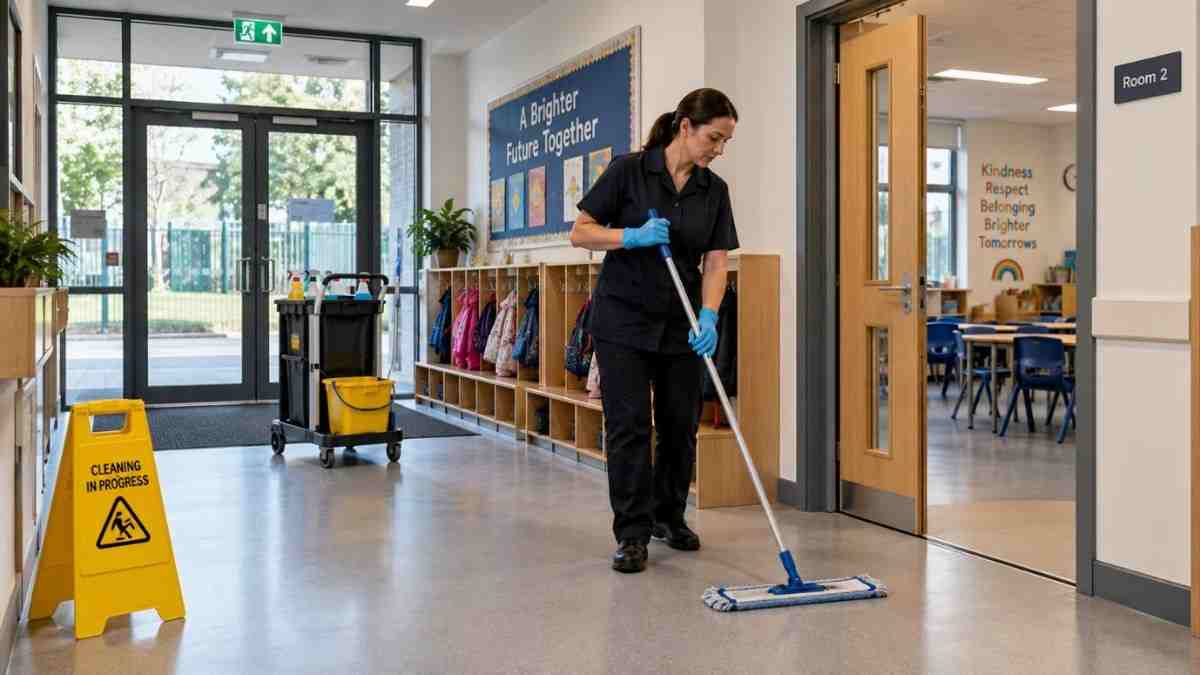
Entrances and corridors take an enormous amount of punishment because nearly everyone in the building passes through them. In Dublin, wet weather adds another challenge, with water and outdoor dirt being carried inside repeatedly during arrival times, breaks and the afternoon rush.
Anyone who has stood near the entrance to a school on a rainy morning knows what happens to the floor.
Children come in wearing wet shoes. Coats are dripping. Dirt gets carried further into the corridor as the morning goes on.
By the afternoon, the entrance can look completely different from how it looked when the doors opened.
These areas can’t be treated as an afterthought. Floors need appropriate attention, but there are also door glass, handles, edges and corners that show heavy use surprisingly quickly.
They’re also the areas parents and visitors tend to see first.
Why Do School Toilets Need Particular Attention?
School toilets can experience concentrated use during relatively short periods of the day, particularly around breaks and lunchtime. Cleaning therefore needs to consider how heavily the facilities are being used, with attention to floors, fixtures, frequently touched surfaces and supplies.
This is one area where you quickly discover whether the cleaning arrangement suits the building.
A toilet block may be quiet during lessons and extremely busy ten minutes later. Supplies can disappear faster than expected, floors can need additional attention and the requirements may change depending on the age and number of pupils using the facilities.
You need cleaners who understand that simply following the same routine regardless of what happened in the building that day isn’t always enough.
How Do Cleaners Work Around Teachers, Pupils and School Staff?
School cleaning works best when it fits around the timetable rather than interfering with it. Cleaners need to know when classrooms become available, which areas remain occupied later in the day and where staff may still be working after pupils have left.
Schools don’t suddenly become empty when the final bell rings.
Teachers may still be preparing lessons. Meetings can be taking place. After-school activities may be running in one part of the building while cleaners are trying to work in another.
We’ve encountered the same reality in many types of commercial premises: the schedule on paper and the building in front of you aren’t always identical.
If a classroom isn’t available, you work somewhere else and return to it. If staff are having a meeting, you don’t start vacuuming outside the door. It sounds obvious, but a surprising amount of good commercial cleaning comes down to common sense and people being aware of what is happening around them.
What Small Things Make a Difference in School Cleaning?
The most noticeable problems aren’t always the biggest ones.
It might be fingerprints across the glass entrance doors, a bin that has filled more quickly than usual, marks around a classroom doorway or grit collecting at the edge of a corridor after several wet days.
Individually, none of these things sounds particularly important. Together, they affect how the building feels when teachers and pupils arrive the following morning.
This is one reason I value cleaners who notice things rather than simply work through a checklist without looking around them.
A checklist is necessary, particularly on a contract, but the person doing the cleaning also needs to use their eyes.
Why Does Consistency Matter in a School Cleaning Contract?
Schools need a dependable standard from one cleaning visit to the next. The building has to be ready again the following day, and school management shouldn’t have to repeatedly point out the same missed areas or chase a cleaning provider over routine work.
That doesn’t mean everything always goes perfectly.
Cleaners get sick. Schools have events. A room can suddenly be used for something that wasn’t on the timetable. Bad weather can create considerably more work than expected.
I’ve never believed in pretending these things don’t happen.
Diamond Shine has a customer review that I particularly like because the customer had used us for several months and openly mentioned one occasion when the experience was “less than perfect”. They also said that we went out of our way to put it right.
That’s a realistic description of a long-term service. You have procedures and people in place to maintain standards, and when an issue does occur, you deal with it.
What Have Years of School Cleaning in Dublin Taught Me?
The main thing I’ve noticed is that schools look completely different when they’re full of children.
That sounds obvious, but it’s important.
A cleaning specification might describe a classroom as a room with desks, floors, bins and surfaces. When you’re actually working there, you see a teacher’s workspace, children’s belongings, displays on the walls and materials being prepared for tomorrow.
The same applies throughout the building. The hall may be used for assembly in the morning and an activity later in the day. Corridors have rush periods. Toilets have rush periods. Entrances behave very differently in November than they do in June.
The cleaning has to work with the school as it really operates.
When pupils and teachers arrive the next morning, they shouldn’t need to think about what happened after they left. The classrooms are ready, the corridors have been attended to and the building is prepared for another busy day.
For me, that’s a good school clean.
If you’re responsible for a school in Dublin and are reviewing your current cleaning arrangements, we’re happy to discuss the premises, timetable and day-to-day requirements before providing a quotation.