By Maria Concas, Founder & Managing Director, Diamond Shine Cleaning
There are certain buildings where you become very aware that cleaning isn’t simply about how the place looks. Medical centres are one of them.
Over the years, Diamond Shine has looked after many different types of commercial premises around Dublin, including healthcare environments. I’ve walked through medical centres when reception is quiet and the day hasn’t properly started, and I’ve seen the same spaces after hours of patients coming and going. They’re very different environments from ordinary offices.
In an office, you might have the same group of people coming through the door every morning. In a busy clinic or medical centre, patients can be arriving throughout the day, children may be sitting in waiting areas, washrooms are in regular use and staff are constantly moving between rooms. Some of the people coming through the door aren’t feeling particularly well either, so you naturally look at the cleaning differently.
What Makes Medical Centre Cleaning Different from Ordinary Office Cleaning?
Cleaning a medical centre differs from general office cleaning because of the way the premises is used. Patient turnover, frequently touched surfaces, waiting areas, washrooms and clinical spaces all place different demands on the building, so the cleaning needs to reflect what is actually happening there each day.
A waiting room that looked perfectly fine at nine in the morning may have had dozens of people through it by lunchtime. Chairs have been used constantly, door handles touched throughout the day and children may have been playing in one corner. A washroom that was immaculate first thing can look very different after several hours of continuous use.
A clinic doesn’t become dirty all at once. It’s the accumulation of all those small contacts throughout the day that you need to be aware of. Good medical centre cleaning in Dublin has to take that into account rather than treating the premises as an ordinary office that simply needs a vacuum and mop at the end of the evening.
Why Do Waiting Rooms and Reception Areas Need So Much Attention?
Waiting rooms and reception areas carry much of the daily traffic in a medical practice. Floors, seating, counters, doors and frequently touched points can see considerable use, while the appearance of reception also affects what patients see when they first walk through the door.
I’ve always found reception areas interesting because they’re where two sides of a medical practice meet. For the staff, it’s a working environment: phones are ringing, appointments are being managed and people are coming to the desk with questions. For the patient, it’s their first impression of the practice.
You notice the little things in these areas. There might be marks on a glass door, dust beneath chairs, rain carried onto the floor on a wet Dublin morning or fingerprints around handles and counters. A waiting area can look tired surprisingly quickly on a busy day.
You also can’t clean a reception area as though nobody uses it. In many practices, staff start early or finish late, and the cleaning has to fit around the people who are actually running the place. That’s a very practical part of working in occupied commercial buildings.
How Should Washrooms Be Managed in a Busy Medical Centre?
Washrooms in medical and healthcare premises need regular, detailed attention because they may experience heavy use from patients, visitors and staff. Fixtures, touchpoints, floors and consumables all need checking, with the frequency reflecting how busy the premises actually is.
Washrooms are also one of the places where problems become obvious very quickly. People notice when supplies haven’t been replenished or a floor needs attention after a wet morning, and they’ll certainly notice if the standard varies noticeably from one day to the next.
The cleaning team needs to understand what normal usage looks like in that particular building. A small appointment-only practice won’t necessarily have the same requirements as a larger centre with patients coming through the doors all day, so the routine needs to make sense for the premises rather than simply following an arbitrary timetable.
Why Do Touchpoints Matter So Much in Healthcare Cleaning?
Frequently touched surfaces deserve particular attention in healthcare environments because the same handles, switches, counters and shared surfaces may be used repeatedly by staff, patients and visitors throughout the day. They’re also easy to overlook if the focus is only on the larger, more visible surfaces.
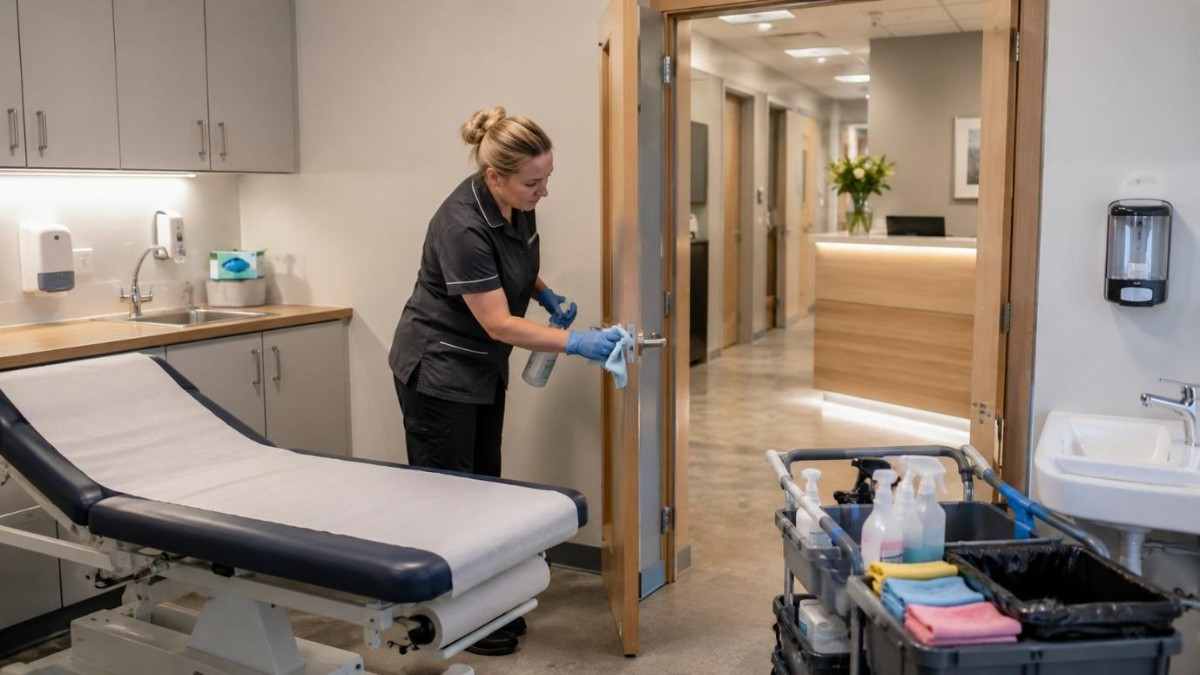
People naturally notice floors, mirrors and worktops. An experienced cleaner also notices the edge of a door where everybody pushes it open, the handle into the washroom, light switches and the reception counter that has been in use all day.
There needs to be an agreed scope and a clear understanding of which areas require particular attention, rather than leaving somebody to make those decisions from scratch each evening. For our contract cleaning work, Diamond Shine provides the cleaning products and equipment and manages staff induction and training as part of the contract.
What About Treatment Rooms and Clinical Areas?
Treatment and clinical spaces need to be approached according to the requirements of the individual healthcare provider. The cleaning company must understand the agreed scope, know which areas it is responsible for and work around any clinical protocols or restrictions set by the practice.
A cleaner should never walk into a medical environment and assume that every room can simply be treated like an office. The practice knows its own clinical requirements; our responsibility is to understand where our work begins and ends, follow the agreed procedures and make sure the people working there understand them too.
At the beginning of a contract, we need to establish which rooms are included, when they’re available, whether there are areas with restricted access and where equipment can or cannot be moved. These are fairly ordinary conversations, but getting them right at the start avoids confusion later.
Why Does Consistency Matter So Much in a Medical Practice?
Healthcare premises need cleaning standards that remain dependable from one visit to the next. Patients and staff shouldn’t see a beautifully maintained waiting room one morning and a noticeably poorer standard the next simply because a different cleaner attended.
There are realities to running any cleaning company that people outside the industry don’t always see. Staff get sick, people take holidays, buildings suddenly become busier and occasionally somebody will miss something. No cleaning company can honestly say that nothing will ever go wrong.
The important thing is how the problem is dealt with. One customer who had used Diamond Shine for several months put this rather well in a review. They said the cleaners were professional and timely but also mentioned that, on one occasion, the experience had been “less than perfect”. They appreciated that we went out of our way to put it right.
I appreciate reviews like that because they reflect real working relationships. A service isn’t only judged on the days when everything goes exactly to plan.
How Do You Clean a Medical Centre Without Getting in Everyone’s Way?
Good healthcare cleaning has to fit around the working life of the practice. Appointment times, staff schedules, patient privacy, access to rooms and opening hours all affect when particular areas can be cleaned and how the team moves through the building.
In practice, that means keeping cleaning equipment out of staff walkways and being prepared for schedules to move. A room that was expected to be empty at six may still have a patient in it at quarter past, while reception staff can be finishing paperwork after the doors have officially closed. You work around it, change the order where necessary and come back to a room later if that’s what makes sense.
A written cleaning schedule is important, but real buildings don’t always run exactly to schedule. The people working in them need to be able to respond sensibly when that happens.
What Have Healthcare Clients Taught Me About Commercial Cleaning?
Years of working across commercial premises have taught me that specialist cleaning starts with understanding what actually happens inside the building. In a healthcare setting, patient traffic, staff routines, shared areas and access all affect the work.
I’ve always found healthcare environments particularly interesting because small details carry more weight. A patient sitting in a waiting room may already be anxious, and while a clean, orderly reception won’t change the reason they’re there, it does help the premises feel properly cared for.
Staff have their own work to concentrate on as well. They don’t want to spend time checking whether washrooms have been attended to, whether reception will be ready in the morning or whether they need to chase the cleaning company.
After years of working in these premises, I’ve found the best arrangements are the ones where everyone understands what is expected and the cleaning adjusts sensibly when the building gets busier or circumstances change. If something isn’t right, it needs to be dealt with rather than becoming another job for the practice to chase.
If you’re responsible for a medical or healthcare premises in Dublin and would like to review your current cleaning arrangements, we’re happy to talk through the building, working hours and requirements before providing a quotation.