Maggie O’Neill, Founder & Managing Director, Diamond Shine Cleaners
A business centre can have several companies behind its doors, each with different working hours and expectations. Cleaning works best when the agreement makes clear which spaces are covered, when cleaners can enter and who can authorise additional work.
An office tenant may assume the kitchen is checked during the day. The centre manager may have arranged an evening clean. Meanwhile, someone booking a meeting room expects it to be ready when their visitors arrive. Each expectation is reasonable, but they need to fit into an agreed service.
For centres such as Sky Business Centres, one of our customers, cleaning needs to fit around the businesses sharing the building. If you manage a similar centre, I’d start by looking at who uses each space, when it’s available to clean and what needs to be ready before the next person walks in.
What makes business centre cleaning different from cleaning one company’s office?
The difference is having several businesses sharing facilities without necessarily sharing the same routine. One tenant might finish at five, another work into the evening, and a third use its office only a few days each week.
That affects access as much as cleaning frequency. An apparently quiet floor may still contain an occupied office. A meeting room might be booked by someone who does not normally work in the building. Shared kitchens can remain busy long after reception closes.
I would start by separating the building into communal areas, private offices and bookable rooms. Each needs its own arrangements. A single instruction to “clean the offices every evening” leaves too much open to interpretation when different people control access to different rooms.
Who is responsible for shared spaces and private offices?
The centre manager and cleaning company should agree responsibility area by area. Tenants also need to know what their office package includes, particularly where communal cleaning and cleaning inside private suites are handled differently.
A useful cleaning specification names the actual spaces: reception, corridors, stairs, toilets, kitchens, meeting rooms and individual offices. It then records the tasks and frequency for each. If private offices have different service levels, those differences should be visible in the instructions.
Bins deserve particular attention. Does the cleaner empty individual desk bins, or do tenants bring waste to a shared collection point? Are recycling containers included? Who replaces the liners?
These are small questions until everyone assumes somebody else is dealing with them. The written arrangements should give reception staff a clear answer when a tenant asks what is included.
How should meeting rooms be cleaned between bookings?
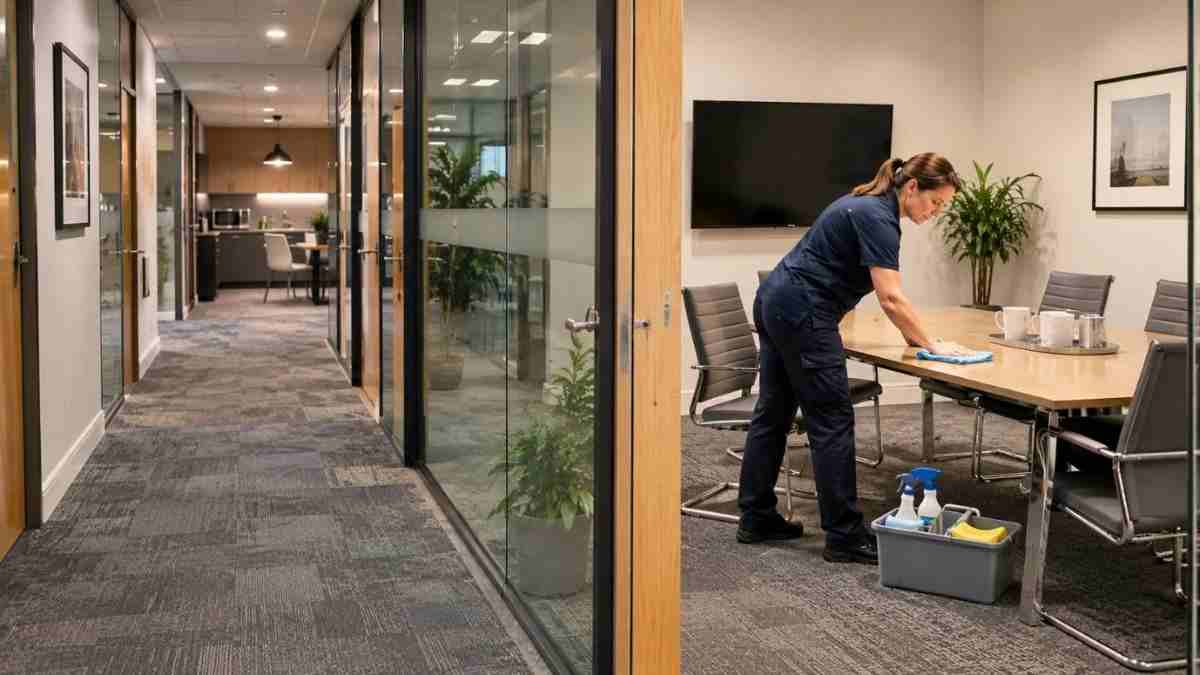
Meeting-room cleaning needs to follow the booking pattern. An evening clean prepares a room for the following morning, but it cannot deal with coffee rings, crumbs and used cups left after a lunchtime meeting.
Where bookings run throughout the day, decide who checks the room between users. That might be centre staff, an agreed daytime cleaning service or a combination of both. Any daytime attendance needs to be included in the service rather than assumed.
Allow a realistic gap between bookings. Clearing refreshments, wiping the table and attending to a spill takes time, particularly after food has been served. A room booked until two cannot always be ready for another group at precisely two.
Room checks should also distinguish cleaning from resetting equipment. Rearranging furniture, testing a screen or reconnecting conference equipment needs separate instructions and a named person responsible.
What happens if a private office is locked or still occupied?
A locked or occupied office needs an agreed response. Cleaners should know whether to return later during the visit, clean only with the occupant’s agreement or record that access was unavailable.
Without that instruction, an office can be missed repeatedly while the tenant believes it has been forgotten. A brief record of the room, time and reason helps the centre manager resolve the access problem.
Where tenants control their own keys, permission to clean should be arranged in advance. An open door is not, by itself, an instruction to enter. Equally, a cleaner should not have to interrupt someone on a call to negotiate the evening’s work.
Agree what happens when access remains unavailable. A return visit outside the normal schedule may need separate approval and a charge, so the arrangement should be clear before it becomes a dispute.
Can cleaners work around confidential paperwork and personal equipment?
Yes, provided the cleaning instructions define what can be touched and what should be left alone. A desk covered in documents cannot receive the same surface clean as an empty desk without someone moving those documents.
My advice is to make clear desks a shared expectation where desk cleaning is included. Tenants can put papers away before the scheduled visit, leaving accessible surfaces ready to clean. Cleaners should not decide which papers are unimportant or rearrange files to reach the desktop.
The same care applies to screens, keyboards, charging cables and personal belongings. Agree whether equipment cleaning is included and which methods are suitable for it. General surface cleaning does not automatically include handling every device.
Confidential waste needs separate instructions too. Documents beside a bin should not be treated as rubbish simply because of where they have been left. Designated containers make that distinction easier.
How often should shared kitchens and toilets be checked?
Frequency should reflect use across the whole building. A kitchen serving several tenants may need attention during the day even when individual offices remain relatively quiet.
Separate the main clean from daytime checks. Cleaning toilets and floors is one task; checking supplies, collecting overflowing waste and responding to a spill is another. Decide who handles each and whether consumables are supplied by the centre or included in the cleaning agreement.
In kitchens, be specific about cups, dishes, dishwashers and food left in fridges. Wiping worktops does not necessarily include washing everybody’s lunch containers. Fridge clear-outs need an agreed notice and disposal procedure.
Review the arrangement when occupancy changes. If a vacant suite becomes a busy ten-person office, the shared facilities may need more attention even though the building’s floor area has not changed.
How should cleaning change when a tenant moves in or out?
A tenant changeover should be assessed separately from the routine clean. Once desks and cabinets are removed, previously hidden dust, marks and floor wear become easier to see.
Confirm when the departing tenant will finish removing belongings and when the incoming tenant needs access. Cleaning before furniture removal is complete can mean doing parts of the job twice. If repairs or decorating are planned, those should be coordinated with the cleaning visit.
Carpet cleaning, upholstery cleaning or detailed internal glass cleaning may need additional time and separate pricing. Drying time also matters when a room must be furnished and occupied shortly afterwards.
Photographs taken with appropriate permission can help record the room’s condition. They make it easier to distinguish something needing further cleaning from a stain, scratch or worn finish that cleaning may not resolve.
Who should approve extra cleaning requests from tenants?
A named centre contact should normally authorise work outside the agreed specification. Tenants can report a problem, but a request to a cleaner should not automatically become an instruction for additional chargeable work.
For example, a tenant might ask for extra cleaning after a catered event. Another might want a carpet attended to before an important visit. Both requests may be manageable, but they affect time and the work scheduled elsewhere.
A simple reporting route helps: the tenant contacts reception or the centre manager, who agrees the task and any cost with the cleaning company. There should also be a clear way to flag something requiring prompt attention during a visit.
Keep the reporting proportionate. A short message identifying the room, problem and required timing is often more useful than a complicated form.
What should a centre manager provide before requesting a quotation?
Provide a floor plan or room list, current occupancy, opening arrangements and a description of how shared facilities are used. Then walk through the building with the cleaning provider so the quotation reflects the actual work.
Identify private offices with restricted access, rooms used outside reception hours and any spaces requiring separate permission. Explain the meeting-room booking pattern and whether daytime checks are expected.
Discuss practical facilities as well: equipment storage, water access, waste collection points and the arrangements for keys or access cards. A cleaning team needs somewhere suitable to keep its equipment between visits.
Finally, ask the provider to separate routine tasks, periodic work and optional extras. Diamond Shine’s contract cleaning service lists cleaning products, equipment, staff induction and contract management within its costs. The quotation for your centre should still state the agreed scope clearly.
How can you tell whether the cleaning arrangement is working?
Check the building at the times that matter to its users. A meeting room may look excellent first thing in the morning but need attention before an afternoon booking. A kitchen checked immediately after cleaning tells you little about lunchtime use.
Review recurring issues by location and timing. If the same office keeps being missed, check access. If kitchen bins regularly fill before the evening visit, review collection frequency. If tenants request work they believed was included, revisit the service description.
This gives the centre manager and cleaning company something specific to resolve. It also makes it easier to review the service when tenants move or occupancy grows.
If you manage a business centre in Dublin, Diamond Shine Cleaners can discuss your shared facilities, private offices and access requirements before preparing a quotation. Bring along the existing specification and any recurring concerns. Those details are a useful place to start.